


















Last March, a low tree branch hung over a walkway outside a shopping mall.
Security guards walked past it. Cleaning crews moved around it. Property managers crossed the area several times a day.
Nobody reported it.
The cameras captured everything. But like most CCTV systems, the footage was stored, not watched.
That gap — between what cameras record and what businesses actually notice — is the gap AI Audit is designed to close.
What AI Audit Actually Means
AI Audit is an AI-powered approach to continuously monitoring operational conditions in physical spaces.
Using existing camera infrastructure, AI systems can detect and analyze issues across stores, restaurants, buildings, and other real-world environments.
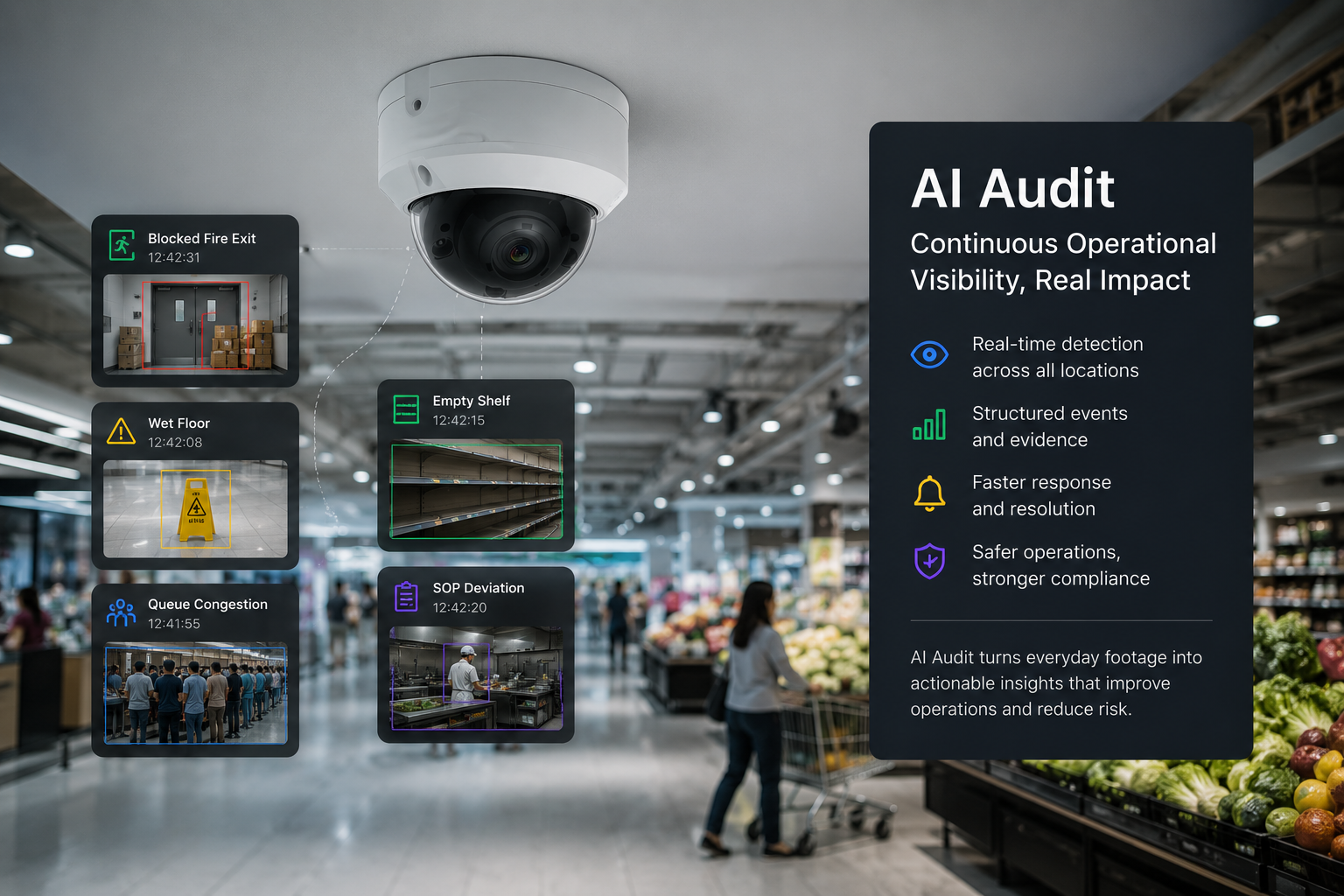
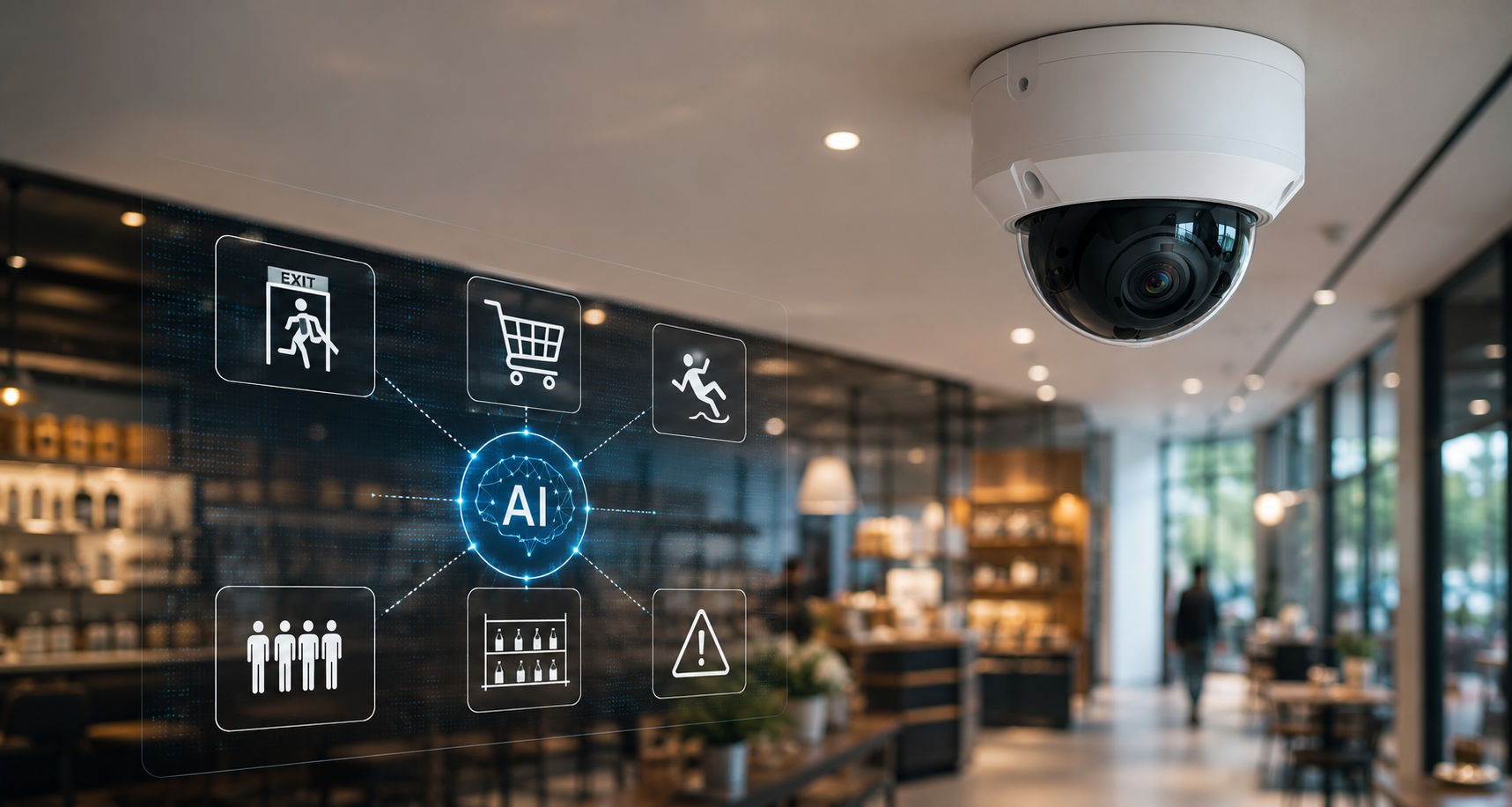
AI Audit focuses on operational conditions such as blocked fire exits, occupied accessibility lanes, wet floors left unattended, empty shelves during peak hours, and SOP deviations in kitchens or service areas.
The goal is simple: identify operational issues early, before they turn into incidents, complaints, or larger operational problems.
Why AI Audit Is Becoming Practical
For years, automated inspection sounded promising in theory, but large-scale deployment was expensive and difficult to manage.
That has started to change for two reasons.
The first is the rise of vision-language models (VLMs).
In the past, many inspection scenarios required dedicated AI models and large training datasets. Detecting a wet floor or an empty shelf often meant building custom systems for each use case.
Today, many operational scenarios can be configured using natural language instructions and lightweight setup.
For example:
“Flag accessibility lanes blocked for more than three minutes.”
This has made AI Audit systems much easier to deploy and scale.
The second shift is the growth of Edge AI.
Instead of sending every video stream to the cloud for analysis, more processing can now happen locally on-site. In many deployments, only structured events and short clips are uploaded, rather than full raw video streams.
This improves efficiency while supporting more privacy-conscious deployments.
How AI Audit Works
Most AI Audit systems follow a simple process.
Existing camera systems connect through protocols such as RTSP or ONVIF. AI systems continuously analyze video streams and convert detected events into structured alerts and searchable records.
At that point, footage becomes more than video storage.
It becomes operational data with context, including time, location, event type, severity, and response status.
This gives enterprises a more continuous view of day-to-day operations.
Over time, businesses can start identifying recurring operational issues, slow response patterns, or problems that appear more frequently during peak hours.
What AI Audit Detects in Practice
Today, AI Audit is already being used across retail, F&B, property, and service environments to identify issues such as empty shelves, queue congestion, blocked fire exits, accessibility lane violations, wet floors, refrigerator doors left open, food safety process deviations, and safety risks in public areas.
Individually, these issues may seem small.
But operational problems often become expensive when they happen repeatedly without visibility.
Traditional inspections rely on periodic checks.
AI Audit enables a more continuous approach to operational oversight.
The Line That Matters: Conditions, Not Individuals
One important principle in AI Audit is focusing on operational conditions rather than individual behavior.
“The floor needs cleaning” is an operational issue.
“How long a specific employee took to clean it” shifts into individual behavior monitoring.
That distinction matters.
It is not only a technology decision, but also a matter of system design and governance.
Beyond CCTV
Traditional CCTV systems mainly record the past.
AI Audit adds a layer of continuous operational awareness.
More importantly, it helps businesses understand physical operations in a more real-time and consistent way.
For many organizations, the value of AI Audit goes beyond reducing manual inspection workload.
It creates greater visibility into how physical operations actually run day to day.
- Check Out Whale's Open Space, Where AI Meets the "Lead to Win" Spirit
- Revolutionizing Production Management with AI
- Whale Debuts Enterprise AI Partner Platform at NRF APAC 2026, Redefining How Businesses Operate with AI
- Insights from Singtel AI Talk: The Future of AI in Retail
- Energy, Passion, and the Future of AI
- Whale at Shenzhen Tour: The Next EV Battleground Is the Operational Excellence
- AI Audit: Why More Enterprises Are Rethinking Inspection
- Introducing Echo
- Whale Secures $60 Million to Expand its Enterprise AI Suite Globally
- Beyond the Hype: What It Actually Takes to Make AI Work in F&B and Retail
- Whale 2026 H1 All Hands: A Fresh Start with AI, Into a New Phase
- How Enterprises Can Leverage AI to Boost Collaboration, Productivity, and Scale
- How GIORGIO ARMANI Redesigned Success Metrics Across Multiple Stores
- 3 Ways to Improve Conversion Rate for the Automotive Industry
- How SpaceSight Works in Standardizing and Improving Operational Efficiency for Car Workshop
- From Browsing to Buying: Use SpaceSight to Optimize Sales Through Product Placement
- How GXG Leveraged Footfall Analytics for Smarter Employee Management
- How Supermarket Chains Improve Inspection Efficiency with Smart Technology
- Four Management Practices to Ensure Food Safety in Your Kitchen
- How SpaceSight Improved Inspection Efficiency for Chain Restaurants
- Build Consistent Customer Dining Experience with SpaceSight Onsite Inspection
- How to Use Footfall Analytics to Improve Customer Service
- Navigating the Future of Retail with AI with OPPO Indonesia
- Why Retail Managers Need Inspection Software for Store Management












 English (Singapore)
-
 Schedule a demoProfessional consultants will provide a brief explanation lasting at least 20 minutes to help you evaluate and use Weve products more efficiently. Please leave your contact information, and we will contact you as soon as possible to schedule a demonstration time.
 -
 Scan to followStay updated with the latest news anytime, anywhere
 TikTok Channel
 LinkedIn Official Account
 -

-
 Customer Service CenterProvide one-on-one consultation and technical support for products and solutions
-
 Back to top